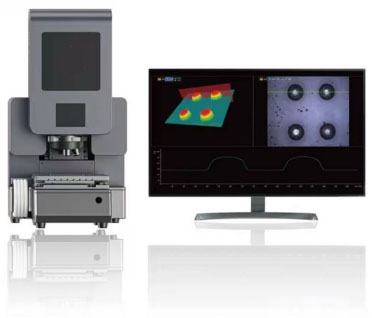
1. Features of Ultra-Deep Field 3D Microscope:
1. Navigation Map:
One-click operation for fast automatic stitching of 3D images. Three stitching modes are available according to sample characteristics: by number of rows and columns, required stitching length, or setting stitching start and end positions. Scanning samples at low magnification to generate a Map navigation map; rapid positioning of observation positions at high magnification for 3D topography analysis. You will not lose the field of view during the analysis process, and even after magnification, the system will display the position of the current field of view in the navigation map.


2. 3D Microscope Automation:
Composed of microscopic imaging system, platform motion control system, PC workstation and professional software system. Realizes one-click completion of acquisition, measurement and analysis with minimal manual intervention. Reduces human errors caused by manual intervention and effectively improves monitoring efficiency. Combined with the data interconnection platform, data can be transmitted to the customer's MES system in real time to further improve data processing efficiency.
3. 3D Image Acquisition:
Overcomes the field of view and depth of field problems of traditional microscopes, and can obtain the 3D topography of products and perform 3D data analysis on them.


4. Movement Efficiency:
The XY axis adopts a linear motor-driven platform, which moves more than 3 times faster than ordinary lead screw-driven platforms.

5. High Measurement Accuracy:
The XYZ three axes are all built-in with 0.1μm high-precision linear scales, which can achieve high-precision positioning. Combined with advanced image algorithms, it provides a strong guarantee for accurate measurement.


6. Motorized Nosepiece:
The XYZ three axes are all built-in with 0.1μm high-precision linear scales, which can achieve high-precision positioning. Combined with advanced image algorithms, it provides a strong guarantee for accurate measurement.


Technical Parameters
Optical System |
Magnification Range |
50X—3000X |
Observation Mode |
Bright field, dark field, mixed light; Polarized light and differential interference are optional |
|
Lens Grade |
Adopts Olympus (Japan) - Plan Semi-Apochromatic Bright/Dark Field Objective Lens |
|
Lens Magnification |
2.5X, 5X, 10X, 20X, 50X, 100X, 150X (Optional) |
|
Magnification Switching |
Motorized Adjustment |
|
Electronic Control System |
Z-axis Stroke |
80mm |
Z-axis Resolution |
0.1μm |
|
Platform Stroke |
Motorized 100mm*100mm; Large-size platform customizable |
|
Platform Load Capacity |
3kg |
|
Platform Specification |
260mm*260mm |
|
Platform Resolution |
0.1μm |
|
Camera System |
Effective Pixels |
1.1 in, 26 Million Pixels |
Pixel Size |
2.5*2.5μm |
|
Field of View Range |
7.24 mm~0.12 mm |
|
Software System |
Panoramic 2D/3D Acquisition Function |
|
Navigation Map Acquisition and Positioning Function |
||
Section Line Measurement Function |
Measures relevant data such as length, width, height, angle, etc. |
|
Plane Measurement Function |
Measures relevant data such as point distance, line distance, arc, angle, area, etc. |
|
☑ Function |
Multi-point Automatic Acquisition Function |
|
Traceability Analysis |
Original File Traceability Analysis |
|
MES Data Interconnection Module Optional |
||
Customizable Software Functions |
||
Image Output Format |
JPG, BMP, PNG, Dimac, etc. |
|
Computer System |
Professional Industrial Computer |
Intel I7, 32G RAM, 512G SSD, 2TB HDD |
DELL Display |
27in 3840x2160 (4K), Brightness 350cd/m², Refresh Rate 60Hz |
|
3. Application Scenarios
 Welding and Riveting Penetration Measurement
 LED
LED
 Microfluidic Channel
 MLCC
MLCC
 Bionics
 Grain Size
 Lithium Battery Burr Detection
 Solar Cell
 VCSEL Chip Detection